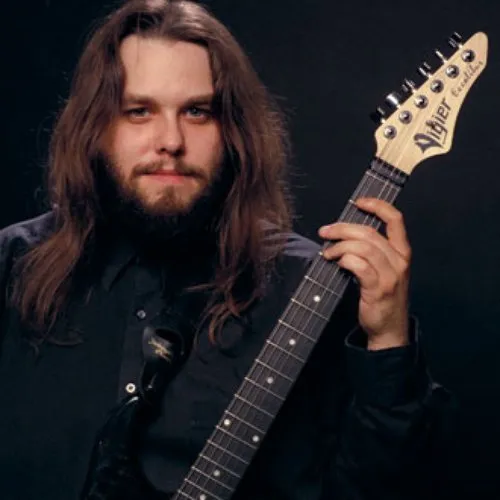
There are fast guitarists, and then there was Shawn Lane. Born in Memphis, Tennessee in 1963, Lane was playing professionally by the age of fourteen - sitting in with Black Oak Arkansas before most kids learn to drive. But speed was never the point. It was a side effect of a mind that processed music faster than the hands of anyone else could follow. Lane thought in complete harmonic sentences at tempos that reduced technique to an afterthought.
He was entirely self-taught - not just on guitar, but in everything. He started playing piano at age eight, studied mathematics, practiced martial arts, and consumed books on Indian classical music, physics, and philosophy with the same intensity he brought to the fretboard. He wasn't a savant. He was a polymath who happened to express most of his genius through six strings.
Memphis: Blues in the Blood
Lane grew up in the shadow of Beale Street. Memphis blues wasn't something he studied - it was the air he breathed. While his later work would incorporate jazz harmony, Carnatic rhythmic structures, and avant-garde textural ideas, the blues never left his playing. Every hyperspeed run eventually resolved into a bend that could make you cry. The vibrato was always there - wide, vocal, rooted in the same tradition as Albert King and B.B. King. He could play faster than anyone alive, but he could also play slower and say more with a single note than most guitarists say in an entire solo.
At fourteen, he joined Black Oak Arkansas as their lead guitarist - a kid playing arena rock with grown men. He even played at Bill Clinton's inauguration as Governor of Arkansas. By his late teens, he was already developing the technique that would later stun the guitar world: a combination of alternate picking, legato, and sweep arpeggios executed at velocities that seemed to break physical limits. Guitar Player magazine named him Best New Talent in their 1992 readers' poll, and players like Vernon Reid, Eric Johnson, Kirk Hammett, and George Lynch had been spreading the word about him for years. But in Memphis, none of that mattered as much as whether you could make a blues lick hurt. Lane could.
The Two-Hand Revolution
Before tapping became a mainstream technique, Lane was using both hands on the fretboard in ways that had no precedent. His approach wasn't the Van Halen model - isolated tapping licks inserted into otherwise conventional playing. Lane integrated two-hand technique into his melodic language so completely that the distinction between picked and tapped notes disappeared. A phrase might begin with alternate picking, shift to legato hammer-ons, erupt into a two-hand arpeggio cascade, and resolve into a bent note - all within a single beat. The transitions were invisible.
His right hand didn't just tap single notes. He used it to add harmony - fretting intervals on the upper fretboard while the left hand held the lower position, creating chord fragments and intervallic leaps that no single hand could reach. Combined with his left-hand legato strength, this gave him an effective range that spanned the entire neck simultaneously.
Picking: The Impossible Standard
Lane's alternate picking was, by most credible accounts, the fastest ever captured on record. But what separated him from other speed players was the clarity. Every note in a 300 BPM sixteenth-note run was articulated - not blurred, not approximated, not hidden behind distortion. Clean or dirty, the notes spoke. He attributed this partly to his practice method: he didn't use a metronome to build speed gradually. He practiced passages at full tempo from the start, accepting imperfection and letting accuracy catch up to intent. The conventional wisdom says this shouldn't work. Lane's playing says otherwise.
His picking motion was unusually efficient - a tiny, controlled movement from the wrist with almost no forearm rotation. The pick barely left the string. This micro-movement is what allowed the extreme velocities: less distance to travel means more repetitions per second. But efficiency alone doesn't explain it. Players who have analyzed Lane's technique frame-by-frame report that the synchronization between his hands was essentially perfect - left and right arriving at the same microsecond, every time, at any tempo.
Lane also developed what he called 'snaps' - a hybrid articulation where the first three notes of a group are picked while the last three are played legato. At speed, this creates rhythmic definition that pure legato blurs and pure picking stiffens. The technique appeared in Paul Gilbert's playing too, but Lane used it differently - as a textural device within longer phrases, not as an isolated lick. His one-note-per-string runs were equally distinctive: descending, only the first of every three notes was picked, the others hammered on; ascending, the first two notes of each triplet were sweep-picked, the last executed by the right-hand middle finger tapping the string. The stacked triads outlined extended chord voicings - Am, C, and Em spelling Am9 across the full range of the neck.
Power Solos: The Pentatonic Architecture
Lane's 1993 instructional video Power Solos (REH Video) revealed the scaffolding behind the speed. At its foundation: five pentatonic positions spanning the entire neck, each built on a two-notes-per-string pattern using primarily the index and ring fingers. Where most guitarists learn pentatonics in box shapes - static grids locked to a single position - Lane's system flowed diagonally across three strings, connecting positions through shared notes. The fingering was deliberately minimal: fingers 1 and 3 did the heavy lifting, keeping the hand relaxed even at extreme tempos.
The real innovation was rhythmic. Lane grouped his pentatonic sequences in fives - quintuplets - rather than the standard fours or sixes. Five notes across two strings, repeating and shifting position, creates a natural rhythmic displacement: the pattern starts on a different beat each time it cycles. This is where pentatonic scales stop sounding like exercises and start sounding like Lane. The groupings of five generate the illusion of acceleration even at a steady tempo, and when combined with actual acceleration, the effect is a cascade that seems to defy the time signature.
Paul Gilbert, no stranger to speed himself, called Lane 'the most terrifying guy of all time.' The back cover of Power Solos quotes Guitar World's assessment: 'lurking inside this firebreathing shredder is a serious composer.' Power Solos proved both right. The video moved from pentatonic foundations through twelve examples of increasing complexity, culminating in complete solo transcriptions from 'Esperanto,' 'Get You Back,' and 'Not Again' - compositions that demanded jazz-level harmonic awareness alongside the velocity.
The Compositions: Harmony Behind the Heat
Power Solos transcribed three compositions that reveal Lane as a harmonic thinker, not just a technical one. 'Esperanto' moves through Dm, E/G#, E/C, and A/F - slash chords that imply modal movement rather than functional harmony, the bass notes creating a chromatic descent while the upper structures shift between major and minor. The solo uses tremolo bar scoops, wide intervallic leaps, and sextuplet groupings that morph into triplets - rhythmic modulation within a single phrase.
'Not Again' opens with chord voicings that belong in a jazz harmony textbook: Dadd9, Bmadd9, Gmaj9(#11), Dsus4, D7, Dm7, D7sus2. Seven chords, each a different shade of D. The Gmaj9(#11) alone - with its Lydian brightness against the surrounding minor and suspended colors - shows a harmonic vocabulary as sophisticated as Holdsworth's. The solo, based around D major with passages shifting into D Dorian and Mixolydian, weaves through the chord tones with triplet phrasing - and near the end, the phrasing takes on a swing feel that sounds not unlike Charlie Parker. Guthrie Govan, who transcribed the solo for Guitar Techniques magazine in 1994, made the observation explicit: 'Like Allan Holdsworth, Lane is thinking in terms of musical ideas, more than in terms of any specific instrument - thus his identity comes across whether he's playing guitar or not.'
'Get You Back' demonstrates Lane's sweep and economy picking at full extension. The solo section features a repeating arpeggio pattern - left hand cycling 2-1-4-2-1-2-4-1 across three strings - that creates a continuous, harp-like cascade of notes over A major changes. The pattern is mechanical in structure but musical in execution: accents shift within each repetition, the dynamics rise and fall, and the resolution into a bent note at the phrase's end grounds everything in blues.
Lane Voicings: Try These
The 'Not Again' chord progression is a masterclass in recoloring a single tonal center. All seven voicings orbit D - major, minor, suspended, dominant - each one a different emotional shade of the same key. These are the actual chord voicings from the Power Solos transcription. Notice how the shapes share common tones: the A (5th) and D (root) anchor the progression while the third and seventh shift around them.
'Not Again' Chord Voicings - Seven Shades of D
"NOT AGAIN" CHORDS  -  from Power Solos (1993)
--------------------------------------------------------------

  Dadd9              Bmadd9             Gmaj9(#11)
  (R-3-5-9)          (R-b3-5-9)         (R-9-7-3-#11-7)

  e -- 0 (E)          e -- 9 (C#)        e -- 2 (F#)
  B -- 3 (D)          B -- 7 (F#)        B -- 2 (C#)
  G -- 2 (A)          G -- 7 (D)         G -- 4 (B)
  D -- 4 (F#)         D -- 9 (B)         D -- 4 (F#)
  A -- 5 (D)          A -- x             A -- 0 (A)
  E -- x              E -- x             E -- 3 (G)

  The 9th (E) rings    Root at fret 9,   Six strings. Lydian
  open on top. Lane    9th (C#) on top.  brightness - the C#
  loved open strings   Dark, spread,     (#11) against B (3rd)
  against fretted      the minor color   and F# (7th) creates
  voicings.            of the sequence.  the widest chord here.

--------------------------------------------------------------

  Dsus4              D7                 Dm7            D7sus2
  (R-5-R-4)          (R-3-b7-R)        (R-5-b7-b3-5) (R-5-b7-2-5)

  e -- x              e -- x            e -- 5 (A)     e -- 5 (A)
  B -- 8 (G)          B -- 3 (D)        B -- 6 (F)     B -- 5 (E)
  G -- 7 (D)          G -- 5 (C)        G -- 5 (C)     G -- 5 (C)
  D -- 7 (A)          D -- 4 (F#)       D -- 7 (A)     D -- 7 (A)
  A -- 5 (D)          A -- 5 (D)        A -- 5 (D)     A -- 5 (D)
  E -- x              E -- x            E -- x         E -- x

  The 4th (G)         The b7 (C) and    Minor third    The 2nd (E)
  replaces the        major 3rd (F#)    (F) darkens    replaces the
  3rd - tension       create dominant   everything.    3rd entirely.
  without darkness.   pull toward G.    Same root,     Ambiguous,
  Wants to resolve.   Resolution chord. new world.     floating.

  --- One tonal center. Seven emotional landscapes. ---
  Play them in sequence: Dadd9 - Bmadd9 - Gmaj9(#11) -
  Dsus4 - D7 - Dm7 - D7sus2. Feel how the harmony shifts
  from major warmth through Lydian brightness into minor
  shadow, all without leaving D's gravitational field.
Pentatonic Positions: The Lane System
Lane's pentatonic system from Power Solos uses two notes per string across three adjacent strings - a diagonal pattern that connects the five positions of the minor pentatonic scale across the entire neck. The fingering is deliberately minimal: index (1) and ring (3) or pinky (4) do all the work. This keeps the hand relaxed at any tempo. The key innovation is grouping these notes in fives - quintuplets - which creates a rhythmic displacement that makes even a basic pentatonic run sound like Lane.
Pentatonic Position #1 - Am Pentatonic, Quintuplet Grouping
LANE PENTATONIC SYSTEM  -  Position #1 in A minor
--------------------------------------------------------------

  TWO NOTES PER STRING (fingers 1-4, 1-4, 1-3)

  e -- - - - - - - - - - - - - - - - - - - - -
  B -- - - - - - - - - - - - - - - - - - - - -
  G -- - - - - - - - - - - - - - - - - - - - -
  D -- 2 (E) - - - 5 (G) - - - - - - - - - -    finger: 1 - 3
  A -- 3 (C) - - - 5 (D) - - - - - - - - - -    finger: 1 - 4
  E -- 3 (G) - - - 5 (A) - - - - - - - - - -    finger: 1 - 4

  Notes: G - A - C - D - E - G (A minor pentatonic)

  THE QUINTUPLET EXERCISE
  Group these 6 notes in fives. The pattern shifts
  its starting beat each time it repeats:

  Beat 1          Beat 2          Beat 3
  |G A C D E|     |G A C D E|     |G A C D E| ...
   1 . . . .       . 1 . . .       . . 1 . .

  Count: 1-2-3-4-5  1-2-3-4-5  1-2-3-4-5
  The downbeat moves. The scale stays the same.
  This is where pentatonic stops sounding like
  a box and starts sounding like Shawn Lane.

  SHIFT TO POSITION #2 (frets 5-8):

  D -- 5 (G) - - - 7 (A) - - -    finger: 1 - 3
  A -- 5 (D) - - - 7 (E) - - -    finger: 1 - 3
  E -- 5 (A) - - - 8 (C) - - -    finger: 1 - 4

  Same scale. New position. Connect them and the
  entire neck opens up - one diagonal line from
  fret 3 to fret 15, two notes at a time.
Five positions cover the full neck. Each shares a note with the next, creating seamless transitions. Practice each position with strict quintuplet groupings at a slow tempo first, then increase speed without changing the grouping. The rhythmic displacement is the point - it's what gives Lane's pentatonic runs their distinctive sense of controlled chaos, as if the notes are tumbling forward under their own momentum.
Carnatic Connections
Lane's immersion in Indian classical music transformed his rhythmic conception. Western guitar players think in fours and threes - 4/4, 3/4, the occasional 7/8 for the adventurous. Lane internalized Carnatic rhythmic cycles - complex subdivisions, rhythmic displacement across long phrases, polyrhythmic structures where the melody and the pulse seem to exist in different time signatures simultaneously. His runs don't just go fast - they create rhythmic illusions, groupings of five over four, seven over three, phrases that land on unexpected beats and make the barline irrelevant.
This wasn't an affectation. Lane studied Indian music seriously, applying the concept of 'tala' - rhythmic cycles that can extend across many bars before resolving - to his improvisation. A Lane solo might establish a rhythmic pattern, displace it by a sixteenth note with each repetition, and arrive back at the downbeat eight bars later with mathematical precision. The listener doesn't hear math. They hear a phrase that creates tension through rhythmic ambiguity and releases it through eventual alignment.
Powers of Ten: The Solo Albums
Lane released only two studio albums under his own name, and both are monuments. Powers of Ten (1992) announced his arrival as a composer and bandleader - not just a technician. The album combined rock intensity with jazz harmony and production that was ahead of its time. Tracks like 'Get You Back' and 'Powers of Ten' demonstrated that Lane could write songs, not just solos. The compositions had structure, dynamics, and emotional architecture that made the virtuosity serve the music rather than the other way around.
The Tri-Tone Fascination (1999) went further. Produced with a confidence that Powers of Ten only hinted at, the album explored deeper harmonic territory - altered dominants, tritone substitutions, modal interchange, and textural experiments that placed Lane closer to Allan Holdsworth than to any shred guitarist. The title itself signals the harmonic sophistication: the tritone - the interval that defines dominant function, the axis around which tonal harmony revolves. Lane didn't just use it. He was fascinated by it.
Hellborg and Sipe: The Power Trio
Lane's most celebrated live work came in a trio with Swedish bassist Jonas Hellborg and drummer Jeff Sipe (also known as Apt. Q258). The three players operated at a level of telepathic interaction that made their concerts legendary. Hellborg's acoustic bass guitar provided a massive, woody foundation. Sipe's drumming was as rhythmically sophisticated as Lane's playing - polyrhythmic, dynamic, capable of shifting feel mid-phrase. And Lane, freed from any compositional obligation, improvised with an abandon that studio recordings could never fully capture.
Live recordings from this trio - particularly the albums Personae and Good People in Times of Evil - capture something that studio work cannot: the sound of three musicians pushing each other past their known limits in real time. The tempos are extreme, the harmonic movement is constant, and the interplay is conversational at a speed that makes most jazz improvisation sound like small talk. These recordings are where Lane's full capability is documented - and they remain some of the most technically demanding music ever performed on the guitar.
The Vigier Excalibur
Lane's relationship with gear evolved as his music did. In the early-to-mid '90s, he favored Ibanez guitars - the Ghostrider and the Talman, the latter a Danelectro-inspired instrument with lipstick tube pickups that he loved for blues work. His amplification came from Bob Gjika in Austin, Texas - handmade tube amps based on Vox AC30 circuits that Lane called 'really awesome.' By the late '90s, he had moved to the Vigier Excalibur - a French-made guitar with a carbon fiber reinforced neck that offered zero dead spots and exceptional sustain. The choice was pragmatic: Lane needed an instrument that could keep up with his technique without fighting back. The Vigier's fast, flat neck profile and precise fretwork allowed the micro-movements his picking style demanded.
His tone was distinctive: thick, saturated, but never muddy. Where most high-gain players sacrifice articulation for power, Lane achieved both. The secret was in his hands more than his gear. His pick attack was precise enough that even through heavy distortion, each note in a rapid passage maintained its own identity. Clean tones, when he used them, revealed a different side - warm, bell-like, with the wide vibrato that betrayed his Memphis roots.
The Mind Behind the Hands
What made Lane truly singular wasn't the speed. It was the integration. He didn't compartmentalize his knowledge - blues here, jazz there, Indian rhythms in this section, shred technique in that one. Everything fed into everything else. A blues phrase would accelerate into a jazz line that would morph into a Carnatic rhythmic pattern that would resolve into a rock bend. The transitions were organic because they came from a mind that saw no boundaries between genres.
His intellectual appetite was legendary among those who knew him. He taught himself to read and speak multiple languages. He studied mathematics and physics at a level that went far beyond casual interest. He practiced martial arts with the same obsessive discipline he brought to music. Friends and collaborators describe a man who was constantly reading, constantly learning, constantly synthesizing information from unrelated fields into his musical conception. The guitar was his primary output, but the input came from everywhere.
Lane's influences ran far deeper than most guitar players would admit to. 'I suppose a lot of flashy Rock guitarists are influenced by Classical music, but only up to the era of Paganini,' he told Guitar Techniques in 1994. 'They never go on to be influenced by the music of Chopin, Liszt or Ravel or Debussy. There are influences that can be drawn from later classical music which can really open your guitar playing up.' He drew equally from jazz pianists - Art Tatum, McCoy Tyner - and from guitarists outside the usual shred canon. He called Ted Greene 'one of the most amazing players I've ever heard,' describing a solo Telecaster improvisation through a Fender amp as 'the most beautiful thing I've ever heard.' Derek Bailey was another touchstone. Lane's listening was as omnivorous as his intellect - Tori Amos, Michael Nyman, and Indian classical music sitting alongside Coltrane and Debussy.
Technique as Vocabulary
Lane rejected the idea that technique and musicality were separate concerns. In his view, technique was vocabulary - the larger your vocabulary, the more precisely you could express what you heard in your head. Speed wasn't an end. It was the ability to say more in the same amount of time. A slow player with limited technique can only express slow, simple ideas. A player with Lane's facility could express ideas at any tempo, any density, any level of harmonic complexity - and choose the right one for each moment.
This philosophy is audible in his playing. Lane's fastest passages aren't flurries of notes for their own sake. They're compressed musical statements - melodic ideas that would take a lesser player four bars to express, delivered in one. And between those eruptions of velocity, there are moments of absolute stillness - a held note, a slow bend, a silence that carries as much weight as the notes surrounding it. The contrast is what makes the speed meaningful.
Hear the System in Action
Theory is one thing. Hearing it is another. The recordings below span the two albums that define Lane's solo legacy - from the arena-rock energy of Powers of Ten through the deep harmonic exploration of The Tri-Tone Fascination. All recordings are the copyrighted property of their respective rights holders and are presented here as brief editorial selections for purposes of music criticism and education under 17 U.S.C. § 107 (fair use). All compositions by Shawn Lane. If you are a rights holder and wish to have a track removed, contact us and it will be taken down immediately.
Playback continues with screen locked
Get You Back - Powers of Ten (1992)
A major refracted through E Mixolydian and back again - the harmony oscillates between two bright centers, never settling, the chromaticism so dense it registers as a continuous spectrum rather than discrete chord changes. A bright, articulate timbral character carries every note forward with crisp definition. The intensity builds through modal contrasts and chromatic inflections toward an emotional peak two-thirds through, where Lane's quintuplet cascades dissolve the song's pop-rock architecture into pure improvisational catharsis.
Gray Pianos Flying - Powers of Ten (1992)
Gb major in perpetual chromatic drift - Ionian, Lydian, Aeolian, and Harmonic Minor dissolving into one another until tonal boundaries become suggestions rather than walls. The brightest spectral character of any track here, shimmering and resonant, the wide bandwidth creating a sense of light refracting through harmonic glass. The architecture builds toward a climactic resolution late in the piece, the end-weighted intensity giving three minutes the emotional gravity of a symphony movement. Barely three minutes, yet containing more harmonic information than most albums. The notes become something surreal, levitational.
Kaiser Nancarrow - The Tri-Tone Fascination (1999)
A minor in its darkest chromatic wardrobe - Harmonic Minor opening into Aeolian and Dorian before a sudden pivot to E Phrygian Dominant introduces an exotic, almost Eastern edge. Named for composer Conlon Nancarrow and channeling his player-piano polyrhythmic philosophy into electric fusion. The intensity is front-loaded, erupting early with crystalline brightness and wide voicings before settling into a slower harmonic rhythm that lets the dense chromaticism resonate. Guitar-keyboard unisons at blazing velocity, the compositional DNA rooted in rhythmic superimposition and metric displacement rather than conventional development.
The Way It Has To Be - The Tri-Tone Fascination (1999)
Eb major woven through Aeolian, Ionian, and Lydian modes until the boundaries between tonal centers blur into shimmering ambiguity. The bright, forward spectral character gives the dense chromaticism an almost electric shimmer. The dynamic architecture is patient - energy gathering steadily through modal interchanges before cresting in the final third, the climax arriving late like a wave that builds for a long time before breaking. A groove-oriented pulse underneath keeps the chromatic explorations grounded, Lane's phrasing riding the space between tenderness and transcendence.
Tri 7/5 - The Tri-Tone Fascination (1999)
G major propelled through Ionian, Mixolydian, and Aeolian modes at a brisk 185 BPM, with excursions into Phrygian and Phrygian Dominant that add dark, exotic gravity to an otherwise bright foundation. The intensity accumulates toward a towering climax near the end - ninety percent of the way through - the end-weighted architecture giving the whole piece a sense of inexorable forward motion. Lane doubles his guitar melodies with his own ethereal voice in unison - a technique borrowed from Carnatic vocal-instrumental tradition - lending the fusion architecture an otherworldly, almost devotional intimacy.
The Hurt The Joy - The Tri-Tone Fascination (1999)
Rooted in A Ionian with a warmth and stability rare in Lane's catalog - the balanced, full-bodied timbre sits lower in the spectrum than anything else here, all resonance and depth. E Mixolydian, A Melodic Minor, and A Lydian weave through the harmony with a faster harmonic rhythm, the rapid modal shifts creating chromatic tension against the song's emotional directness. The arc is patient and end-weighted, building through gradual accumulation toward a powerful climax in the final fifth. Piano and guitar converse as equals, the sustained emotional arc living in the space its title names - hurt and joy held simultaneously, neither resolving into the other.
Song For Diane - The Tri-Tone Fascination (1999)
A major as a restless tonal center - Ionian, Dorian, and Melodic Minor give way to Phrygian Dominant and Harmonic Minor, the harmony in constant chromatic motion, the stability the lowest of any track here. The warmth of a balanced, mid-range timbre lets every modal color resonate fully - no brightness to mask the harmonic complexity. A rapid harmonic rhythm drives the piece through continuous tonal pivots while the tempo stays relaxed at 112 BPM, creating the paradox of urgency within stillness. The album's valedictory meditation - the virtuoso's velocity distilled into patience, long singing phrases that resolve not into silence but into continuation.
All recordings are the property of their respective labels and the Shawn Lane estate. They are presented here solely for purposes of critical commentary and music education. Support the artist's legacy: Powers of Ten and The Tri-Tone Fascination are available on streaming platforms and through specialty retailers.
Legacy: The Ceiling Raised
Shawn Lane died on September 26, 2003, at forty years old, from complications related to a chronic lung condition that had plagued him for years. He left behind two solo albums, a handful of trio recordings, scattered live footage, and a reputation that only grew after his death. He never achieved mainstream fame. He was too uncompromising for that - too willing to follow his musical instincts into territory that had no commercial value and no precedent.
What he left behind is a standard. Not a style to copy - Lane's playing is too personal, too integrated with his specific intellect and physical gifts to be replicated. But a standard of what's possible when technique serves a musical imagination without limits. He proved that the fastest playing can also be the most musical. He proved that blues, jazz, Indian classical music, and rock aren't separate languages but dialects of the same one. And he proved that the ceiling on the guitar - the absolute limit of what the instrument can do in human hands - was much higher than anyone before him had reached.
In his 1994 Guitar Techniques interview, Lane offered advice that captures his philosophy better than any technical analysis: 'Sometimes players get so into building up their chops that they don't find their own identity by just making music. There's valid music to be made at any technical level. I've heard music at the most primitive technical level that's brilliant.' From the man who could play faster than anyone alive - that's the message worth keeping.