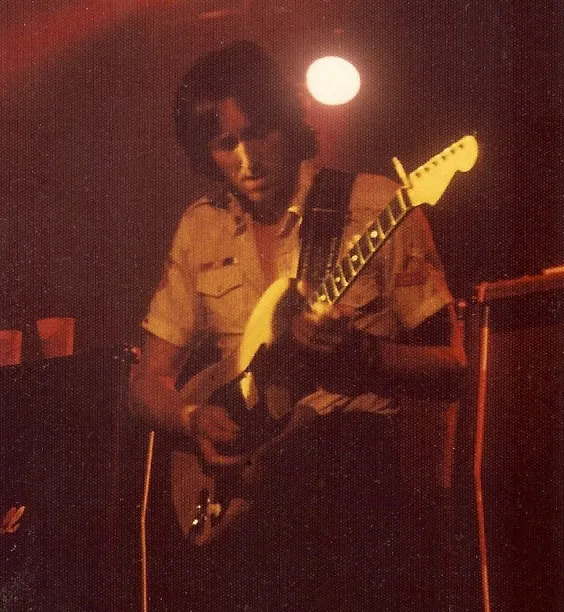
Frank Zappa said Allan Holdsworth 'single-handedly reinvented the electric guitar.' Eddie Van Halen called him 'the best, in my book.' Joe Satriani, John McLaughlin, Carlos Santana, Guthrie Govan - every generation of guitarist circles back to the same name. But Holdsworth never set out to reinvent anything. He just couldn't stand the way guitar sounded compared to the instruments he actually loved.
Born in Bradford, England in 1946, Holdsworth grew up listening to his father's jazz records - saxophone players, mostly. When he picked up the guitar as a teenager, he didn't hear it the way other guitarists did. He heard everything it couldn't do. The sustain died too fast. The notes separated where they should have flowed. The chords sounded flat and predictable. So he decided to fix all of it.
The Phonebook from Hell
Most guitarists learn scales from a book or a teacher - major, minor, pentatonic, the modes. Holdsworth rejected all of it. While still a teenager, he sat down and calculated every possible scale that could be built from the twelve notes in an octave, writing out hundreds of combinations by hand. He called the result his 'Phonebook from Hell.' Then he played through every single one, listening critically, rejecting anything that felt too crowded or too predictable, keeping only the scales that resonated with something he couldn't name but could hear.
This wasn't a shortcut - it was the opposite. While other guitarists memorized the seven modes and moved on, Holdsworth mapped the entire harmonic territory before choosing where to live. The Lydian scale, the diminished, the harmonic major, the augmented, the whole tone, the altered - he absorbed them all, but on his own terms, with his own fingerings, derived from his own logic.
Four Notes Per String: The Saxophone Principle
The standard guitar method teaches scales with two or three notes per string. It's practical, comfortable, and produces a recognizable guitar sound - the kind of sound Holdsworth wanted to escape. He realized that if he played four notes per string instead, the fingerings stretched wider but the lines became fluid, connected, almost without seams. The pick could be eliminated in favor of legato - hammer-ons, pull-offs, and slides replacing the percussive attack of a plectrum.
The goal was to sound like a saxophone - a single breath carrying a melody from start to finish, with no gaps where the string changed. He didn't want to hear the mechanism of the instrument. He wanted to hear only the music. As he described it: 'I recognize and see certain scales. I don't think about what the root is. I just see a permutation of intervals. When I look at the neck, the notes just light up.'
Chords as Colors, Not Shapes
This is where Holdsworth's approach becomes genuinely unique - and genuinely difficult to teach. He didn't think of chords as shapes on a fretboard. He heard them as colors. In his own words: 'The harmony is one color and you can get two or three things that come along on top of it, that match it. I like playing things that some say would be a diatonically incorrect note. But it's really not, depending on how it's played. It's really appealing to me to weave in and out of these colors.'
In practice, this meant building voicings from intervals rather than memorized grips. His signature sound comes from four-note structures spread across two octaves - stacks of fifths, wide intervals that avoid octave doubling, clusters of seconds that create tension without resolution. Where a conventional jazz guitarist might play a Cmaj7 as a compact shape in one position, Holdsworth would voice it as G-D-A-E spread across five frets and three octaves, creating a chord that technically functions as C6/9 but sounds like an open sky.
The Inversion Method
Rather than memorizing hundreds of chord shapes, Holdsworth used a systematic approach: take any voicing, identify its notes within an octave, then methodically invert it - moving the lowest note to the top, then the next, exploring every permutation on the same set of strings. Each inversion reveals a new color from the same raw material. As Jens Larsen observed in his analysis, 'stacks of fifths seem to reappear in these voicings' - suggesting that the interval of a perfect fifth was Holdsworth's architectural foundation, the brick from which he built everything.
This is the key insight from his book Melody Chords for Guitar: he doesn't teach you to play like him. He presents chord scales - every chord available from a given mode - and expects you to find your own voice within the system. Major, minor, altered, dominant, diminished - all laid out in voicing form, not as recipes but as raw material. The same philosophy appears in Reaching for the Uncommon Chord, where note-for-note transcriptions of compositions like Tokyo Dream, Shallow Sea, and Letters of Marque reveal how the theory becomes music.
Melody Chords: The System Behind the Sound
In 1997, Holdsworth published Melody Chords for Guitar - a book that confused almost everyone who bought it. It wasn't a chord dictionary. It wasn't a scale book. It was both, fused together into a system that treats chords and scales as two views of the same thing. 'My approach to chords has always been as groups of notes that imply a certain scale,' he explained in Guitar Magazine. 'I think of chords as belonging to a certain key, which implies a given diatonic scale. I can then play any note that is diatonically correct for that scale that sounds good to me.'
The book's method is deceptively simple. Take a major scale - G major, for example: G A B C D E F#. Number each note 1 through 7. Now, for each scale degree, Holdsworth shows every chord voicing that can be built using that note as the melody (top) note, using only diatonic notes from the parent scale. Then he adds the 'altered' notes - each scale degree raised or lowered by a half-step - and shows the chord voicings those create. The result is a complete map of every harmonic color available in a key, organized not by chord symbol but by melody note position on the first, second, and third strings.
This is the paradigm shift. Most guitarists learn a Gmaj7 shape and file it under 'G major seventh.' Holdsworth files it under 'what chords have F# on top in the key of G.' The melody note drives the voicing choice, not the chord name. This is why he could harmonize any melody instantly - he wasn't thinking about chord changes, he was thinking about which colors belonged under each melody note.
The book covers four harmonic territories in sequence: major scales in chord form, minor scales in chord form, dominant scales, and diminished dominant scales. Each territory gets its own set of chord voicings across all twelve keys, with reference tables showing fingerboard positions of every scale note on every string. The system is exhaustive - and deliberately so. Holdsworth didn't want to teach you a few nice chords. He wanted to give you the raw material to find every chord that exists within a key, and then let your ear decide which ones matter.
Holdsworth Chord Voicings: Try These
The voicings below demonstrate Holdsworth's core principles: wide intervals, minimal notes (three or four rather than six), no octave doubling, and melody note on top. Each voicing is shown in the key of G - to transpose, move the entire shape up or down the neck. These are built using his methodology: start with the scale, choose a melody note, build intervals underneath that create color without clutter. Notice how changing a single note transforms major into minor, or diatonic into altered - this is the economy of the system.
Major Family - Wide Voicings in G
HOLDSWORTH-STYLE MAJOR VOICINGS  -  Key of G
--------------------------------------------------------------

  Gmaj7              Gmaj9              Gmaj7(#11)
  (R - 3 - 7)       (3 - 7 - 9)       (R - #11 - 7)

  e -- x              e -- 5 (A)         e -- x
  B -- 7 (F#)         B -- 7 (F#)        B -- 7 (F#)
  G -- 4 (B)          G -- 4 (B)         G -- 6 (C#)
  D -- 5 (G)          D -- x             D -- 5 (G)
  A -- x              A -- x             A -- x
  E -- x              E -- x             E -- x

  3 notes, wide.      Rootless. Floats.   Lydian color.
  Root grounds it.    Pure upper           The #11 (C#) creates
  The 5th is absent   structure.           brightness against
  - not missed.       Let the bass         the major 7th.
                      provide the root.
Minor Family - Dark Colors in G
HOLDSWORTH-STYLE MINOR VOICINGS - Key of G
--------------------------------------------------------------
Gm7 Gm9 Gm(maj7)
(R - b3 - b7) (b3 - b7 - 9) (R - b3 - 7)
e -- x e -- 5 (A) e -- x
B -- 6 (F) B -- 6 (F) B -- 7 (F#)
G -- 3 (Bb) G -- 3 (Bb) G -- 3 (Bb)
D -- 5 (G) D -- x D -- 5 (G)
A -- x A -- x A -- x
E -- x E -- x E -- x
Same architecture Rootless minor 9. The minor-major 7th:
as the maj7 shape Bb - F - A: Holdsworth's favorite
- b3 replaces 3, melancholy without tension. Bb against F#
b7 replaces 7. weight. - pure yearning.Dominant Family - Tension and Resolution in G
HOLDSWORTH-STYLE DOMINANT VOICINGS - Key of G
--------------------------------------------------------------
G7(#11) G13 G7(b9)
(R - #11 - b7) (R - 13 - 3 - b7) (R - 3 - b7 - b9)
e -- x e -- x e -- 4 (Ab)
B -- 6 (F) B -- 6 (F) B -- 6 (F)
G -- 6 (C#) G -- 4 (B) G -- 4 (B)
D -- 5 (G) D -- 2 (E) D -- 5 (G)
A -- x A -- x A -- x
E -- x E -- 3 (G) E -- x
Lydian dominant. 4 notes - root, The altered dominant.
The #11 rubs 13th, 3rd, b7. Ab (b9) on top creates
against the b7. Rich without maximum tension -
Resolves naturally clutter. The E the chord that begs
to Cmaj7. (13th) adds warmth. to resolve.Notice the architecture. Each family uses the same three inner strings (D-G-B) as its foundation, with extensions to the outer strings for four-note voicings. This is deliberate - Holdsworth built voicings in families that share the same string group, so moving between related chords requires minimal hand movement. Change one note in the Gmaj7 voicing and you get Gm7. Lower the 7th by a half-step and you get G7. The shapes are related because the harmony is related - and this is exactly how the Melody Chords system is organized.
Chord Sequences: One Symbol, Many Colors
One of the most practical ideas from Melody Chords for Guitar: when a chart says 'Gmaj' for eight beats, don't play the same voicing eight times. Instead, move through a sequence of related voicings that all belong to G major - each one a different shade of the same color. The melody note on top changes with each voicing, creating a counter-melody within the harmony. Holdsworth called these 'chord sequences in harmony accompaniments' - and once you hear them, static chord comping sounds like a limitation you didn't know you had.
Chord Sequence - G Major, 8 Beats
CHORD SEQUENCE OVER G MAJOR  -  one voicing per beat
--------------------------------------------------------------

  Beat:  1          2          3          4
         Gmaj7      Gmaj6      Gmaj9      Gmaj7

  e --   x          x          5 (A)      x
  B --   7 (F#)     5 (E)      7 (F#)     7 (F#)
  G --   4 (B)      4 (B)      4 (B)      4 (B)
  D --   5 (G)      5 (G)      x          5 (G)
  A --   x          x          x          x
  E --   x          x          x          x

  Beat:  5          6          7          8
         Gmaj6      Gmaj7      Gmaj9      Gmaj6/9

  e --   x          x          5 (A)      5 (A)
  B --   5 (E)      7 (F#)     7 (F#)     5 (E)
  G --   4 (B)      4 (B)      4 (B)      4 (B)
  D --   5 (G)      5 (G)      x          5 (G)
  A --   x          x          x          x
  E --   x          x          x          x

  The B (3rd) on the G string stays constant - an anchor.
  Everything else moves around it. One chord symbol,
  eight different colors. Top-note melody: F# E A F#
  E F# A A - a counter-melody emerges from the harmony.
This technique transforms static harmony into living texture. A pianist does this naturally - comping through a jazz standard, they never play the same voicing twice in a row. Holdsworth brought that sensibility to the guitar, where most players grip one shape and strum. The Melody Chords system makes this possible by organizing voicings not by chord name but by scale position - so you can see at a glance every voicing available under a given harmony, and move between them in real time.
The Chord Solo: Melody Through Harmony
The deepest application of Holdsworth's system is the chord solo - playing a melody where every note is harmonized with a full voicing underneath. Take a melody. Identify each note as a scale degree in the key. For each degree, select a chord voicing from that position in the chord-scale system - with the melody note sitting on top and chord voices filling in below. The result is a complete arrangement for solo guitar where melody and harmony are inseparable.
Holdsworth demonstrates this in the book with 'Greensleeves' - a melody everyone knows, harmonized with his chord-scale system into something that sounds nothing like the folk song you expect. Every melody note gets its own voicing. The harmony shifts with every note of the tune, creating a continuously moving color palette under a familiar line. He also includes 'Londonderry Air' as a supplementary example, showing how the same principles apply across different melodies and keys. The method is always the same: locate the melody note on the fingerboard, find it in the reference table as a scale degree, then select the chord voicing from the corresponding position in the system.
This is what separates Holdsworth's book from every other chord reference ever published. A chord dictionary gives you shapes to memorize. Melody Chords for Guitar gives you a system to derive any chord from first principles - and then shows you how to use those chords to harmonize melody in real time. The dictionary makes you dependent on what it contains. The system makes you independent of everything except your own ear.
Five Experiments: How Holdsworth Derived New Voicings
The book's most practical chapter presents five experiments for generating voicings from raw material. These aren't exercises to memorize - they're methods to apply to any chord in any key, forever. Each experiment builds on the previous one, and together they explain how Holdsworth could produce seemingly infinite voicings from a finite set of notes.
- Experiment 1 - String Transfer: Take any note in a voicing and move it to an adjacent string at a different octave. The chord symbol doesn't change, but the spacing transforms the sound completely. A tight cluster becomes an open landscape.
- Experiment 2 - Scale Note Addition: Take any three-note voicing and add a fourth note from the parent scale. Every added note creates a different chord quality. A triad becomes a seventh chord, a ninth chord, a sixth chord - same foundation, different roof.
- Experiment 3 - Close Harmony Permutations: Arrange all four notes within a single octave. Then rotate: move the bottom note to the top, creating a new inversion. Four notes yield four close-position voicings, each with a different melody note on top.
- Experiment 4 - Open and Extended Harmony: Take each close-position voicing and drop one voice down an octave. One close chord generates four open voicings - wider intervals, more air between the notes, more of the sound Holdsworth was after.
- Experiment 5 - Combine Everything: Apply string transfers to open voicings. Add scale notes to inversions. Drop voices from extended chords. The combinations are effectively infinite, and that's the point. The system doesn't give you chords to play - it gives you a method to find chords nobody has played.
Close to Open: One Chord, Five Voicings
This is Experiment 4 in action. Start with a Gmaj7 in close position - all four notes (G, B, D, F#) packed within a single octave. Then drop each voice in turn down an octave to create four open voicings. Same four notes, five completely different sounds. Holdsworth would work through this process for every chord in every key, building a vocabulary of hundreds of voicings from a handful of raw chords.
Gmaj7 - Close Position to Open Voicings
CLOSE → OPEN VOICING DERIVATION  -  Gmaj7 (G B D F#)
--------------------------------------------------------------

  CLOSE (all within one octave)

  e -- 2 (F#)      All four notes packed tight:
  B -- 3 (D)       G3 - B3 - D4 - F#4.
  G -- 4 (B)       Dense, pianistic. Not very
  D -- 5 (G)       "guitar" - which is why most
  A -- x            players never find it.
  E -- x

  OPEN 1            OPEN 2            OPEN 3            OPEN 4
  (drop G)          (drop B)          (drop D)          (drop F#)

  e -- 2 (F#)       e -- 2 (F#)       e -- 2 (F#)       e -- x
  B -- 3 (D)        B -- 3 (D)        B -- x             B -- 3 (D)
  G -- 4 (B)        G -- x            G -- 4 (B)         G -- 4 (B)
  D -- x            D -- 5 (G)        D -- 5 (G)         D -- 5 (G)
  A -- x            A -- 2 (B)        A -- 5 (D)         A -- x
  E -- 3 (G)        E -- x            E -- x             E -- 2 (F#)

  G two octaves     B dropped below   D dropped below    F# in the bass -
  below the rest.   the root. Wide,   the root. The 5th  Holdsworth loved
  Massive spread.   airy, Holdsworth  anchors from       this inversion.
  Pure open sky.    signature sound.  below. Grounded.   Unexpected root.
Five voicings from one chord. Now imagine doing this for every inversion of every chord in every key, across major, minor, dominant, and diminished territories. That's what the book contains - and that's why Holdsworth never ran out of chords. He didn't memorize shapes. He memorized a process.
Substitute Notes: Recoloring Without Leaving the Key
One of the most powerful tools in Melody Chords is note substitution - replacing a chord tone with an adjacent scale degree. The chord symbol might stay 'Gmaj7' on the chart, but the voicing underneath tells a different story. Holdsworth identified three primary substitutions: the 9th replaces the root (A for G), the 4th replaces the 3rd (C for B - he called this the 'delayed third'), and the 6th replaces the 5th (E for D). Each substitution stays diatonic - every note belongs to G major - but the color shifts dramatically.
Substitute Notes - Gmaj7 Recolored
SUBSTITUTION FROM ONE SHAPE  -  all diatonic to G major
--------------------------------------------------------------

  Standard Gmaj7     9 for Root         4 for 3rd          6 for 5th
  (1 - 3 - 5 - 7)   (9 - 3 - 5 - 7)   (1 - 4 - 5 - 7)   (1 - 3 - 6 - 7)

  e -- 2 (F#)        e -- 2 (F#)        e -- 2 (F#)        e -- 2 (F#)
  B -- 3 (D)         B -- 3 (D)         B -- 3 (D)         B -- 5 (E)
  G -- 4 (B)         G -- 4 (B)         G -- 5 (C)         G -- 4 (B)
  D -- 5 (G)         D -- 7 (A)         D -- 5 (G)         D -- 5 (G)

  The textbook       Rootless. Floats   The "sus" sound.   The 6th (E) where
  voicing. Stable,   above the bass.    C delays the B -   the 5th was. Open,
  familiar.          Ambiguous - is     the ear expects    pastoral, almost
                     it Gmaj9 or Am7?   resolution that    folk-like. Same
                     Both. Neither.     may never come.    key. New world.

  --- One note changes. Everything else stays. ---
  This is why Holdsworth could play over one chord
  symbol for sixteen bars and never repeat a color.
Chord Bending: The Chromatic Slither
Holdsworth's most visceral technique: hold the melody note fixed on top, then slide an inner voice chromatically - one fret at a time - while the outer frame stays still. He called the parallel version a 'chromatic slither.' The chord morphs continuously, passing through identifiable harmonies and unnamed in-between colors. In contrary motion, the melody moves one direction while an inner voice moves the opposite way. The effect is a chord that breathes - expanding and contracting like a living thing.
Chord Bending - Parallel and Contrary Motion
CHORD BENDING  -  inner voice moves, frame holds
--------------------------------------------------------------

  PARALLEL MOTION (melody F# fixed, inner voice descends)

  Step 1: Gmaj7      Step 2: Gm(maj7)   Step 3: Gadd9
  e -- x              e -- x              e -- x
  B -- 7 (F#) ●       B -- 7 (F#) ●       B -- 7 (F#) ●
  G -- 4 (B)  ↓       G -- 3 (Bb) ↓       G -- 2 (A)
  D -- 5 (G)          D -- 5 (G)          D -- 5 (G)

  Major 3rd (B).     Minor 3rd (Bb).    No 3rd at all -
  Bright, resolved.  Dark, yearning.    just root, 9th, 7th.
                                        Floating, ambiguous.

  One finger slides down the G string. The chord
  transforms from major → minor → suspended color.
  Three frets. Three emotional worlds.

  --------------------------------------------------

  CONTRARY MOTION (3rd descends, 7th ascends)

  Start: G7           End: Gm(maj7)
  e -- x               e -- x
  B -- 6 (F)  ↑ +1     B -- 7 (F#)
  G -- 4 (B)  ↓ −1     G -- 3 (Bb)
  D -- 5 (G)           D -- 5 (G)

  The 3rd drops (B → Bb) while the 7th rises (F → F#).
  Two voices move in opposite directions. G dominant 7th
  becomes G minor-major 7th - a complete harmonic
  inversion through two half-steps. This is how
  Holdsworth made chords breathe.
Chord bending is where Holdsworth's system stops being theoretical and becomes physical. You feel the harmony shift under your fingers. The melody note rings steady while the inner architecture rearranges itself - and because the motion is chromatic, it passes through dissonances that resolve naturally into the next chord. This is what people mean when they say Holdsworth made the guitar sound like an orchestra.
The Diminished Dominant: Four Keys from One Shape
The fourth harmonic territory in Melody Chords is the diminished dominant - and it's where Holdsworth found his darkest colors. A diminished seventh chord is perfectly symmetrical: four notes, each a minor third apart. Gdim7 contains G, Bb, Db, and E. But here's the structural insight: those same four notes also spell Bbdim7, Dbdim7, and Edim7. One shape, moved up three frets, gives the same chord. There are only three unique diminished seventh chords in all twelve keys.
Holdsworth exploited this symmetry ruthlessly. Each note in a dim7 chord can function as the flat-9 of a dominant chord a half-step below. So Gdim7 (G-Bb-Db-E) connects to four dominant chords: F#7(b9), A7(b9), C7(b9), and Eb7(b9). One diminished shape gives you instant access to four keys. Move it up one fret - a new set of four. Up another fret - the last set. Twelve dominant chords covered by three shapes. This is how Holdsworth could modulate across distant keys in a single phrase without the harmony feeling forced. The diminished chord is the secret corridor connecting rooms that shouldn't be adjacent.
The book devotes an entire section to diminished dominant chord voicings across all twelve keys, showing how to voice them with the same close-to-open methods used for major and minor territories. The result is a set of voicings that sound menacing, unstable, full of tension - and because of the symmetry, they can resolve in four different directions. Holdsworth used these as pivot points: approach from one key, pass through the diminished corridor, emerge in another. The listener doesn't hear theory. They hear color shifting like weather.
Greensleeves: Three Levels of Chord Selection
The book's climactic demonstration is a chord solo arrangement of 'Greensleeves' in E minor - a melody everyone can hum, harmonized three different ways using increasing levels of the system. Each level uses the same melody, the same key, the same fretboard. The only thing that changes is how deep you reach into the chord-scale vocabulary.
- Level 1 - Standard Selection: Each melody note gets the simplest diatonic chord that contains it. E gets Em. G gets Em or G major. B gets Em or B minor. The harmony is correct, familiar, predictable. This is how most guitarists would arrange the tune - and it works. But every chord is a shape you already know.
- Level 2 - Progressive Selection: Each melody note gets an extended voicing - ninths, elevenths, major sevenths. The melody note E over an Em chord might become the 9th of a Dmaj9 voicing, or the 5th of an Am7. The chord symbols are more complex, but every note still belongs to E natural minor. The tune starts to shimmer - same melody, richer light underneath.
- Level 3 - Substitute Selection: Chord tones are replaced with adjacent scale degrees. The root gives way to the 9th. The 3rd is delayed to the 4th. The 5th becomes the 6th. The voicings no longer resemble any standard chord shape - they're derived from the system, not from memory. The melody floats on top of harmony that's continuously surprising but never wrong. This is the Holdsworth sound: familiar on top, alien underneath.
The three levels aren't meant as beginner-intermediate-advanced. They're three aesthetic choices available simultaneously. Sometimes the straight-forward voicing is the right color. Sometimes you need the substitute chord to make the melody breathe. Holdsworth's point is that you should have all three available - and the only way to get there is to internalize the system deeply enough that you stop thinking about chord names and start hearing chord colors. The Greensleeves demonstration proves it works: the same eight bars of melody, harmonized three ways, sound like three different compositions.
He follows Greensleeves with 'Londonderry Air' in C major - same method, different key, different emotional territory. Where Greensleeves is modal and dark, Londonderry Air is lyrical and bright. The substitute chords create passing harmonies between the standard changes, and dynamics become part of the voicing strategy - softer for substitute chords, stronger for resolution points. The melody carries itself. The chords just decide what color the light is.
Modal Thinking: Every Note Is Available
Most jazz improvisation works within the chord-scale system: each chord gets its own scale, and you navigate the changes by switching scales at each bar. Holdsworth found this mechanical. Instead, he took a modal approach - if a chord belongs to a key, then every note in that key is available over that chord. Not just the 'correct' chord tones, but all seven (or more) notes of the parent scale, used freely, weighted by the ear rather than by the rule book.
He didn't separate modes from each other. Where most guitarists think of Dorian as one pattern and Mixolydian as another, Holdsworth saw them as the same scale starting from different points - and used the entire fretboard for each one, without positional boundaries. The result is that dissonance and consonance become a continuous spectrum rather than a binary switch, and 'wrong' notes only exist if you can't hear where they're going.
The SynthAxe: Beyond the Guitar
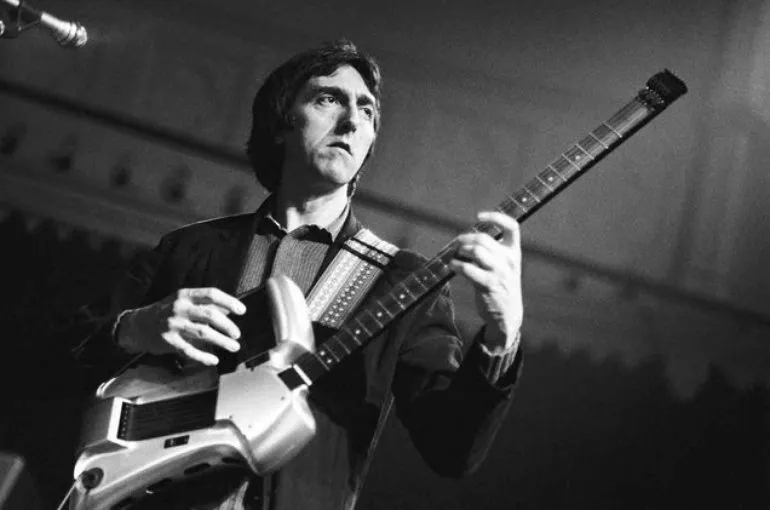
In 1986, Holdsworth became the most visible proponent of the SynthAxe - a guitar-shaped MIDI controller with keys, string triggers, and a breath controller called the Masters Touch. It wasn't a gimmick. The SynthAxe was the logical endpoint of his lifelong desire to make the guitar sound like a horn. With breath control shaping dynamics and volume, he could finally play with the phrasing of a saxophone player - swelling into notes, tapering phrases, sustaining without decay.
The Atavachron album (1986) was the first full realization of this vision. The instrument gave Holdsworth access to textures no guitar could produce while preserving the fretboard interface his fingers had spent decades learning. When the SynthAxe company folded, he continued using his original units until they literally fell apart - there was no replacement for what they gave him.
Improvisation as Unconscious Release
Holdsworth's philosophy of improvisation might be the most important lesson he left behind, and the hardest to follow. 'Improvisation must be an unconscious release of things you already know somehow,' he said. 'Usually, anything I'm working on is something I can't force to happen. If I try to make something happen, it doesn't sound right. It takes maybe a couple of years before something I'm working on now will find its way out naturally.'
This is the opposite of how most musicians practice. The standard method is: learn a concept, drill it, perform it. Holdsworth's method was: absorb a concept, forget about it, wait for it to emerge on its own. He would erase recorded solos if he heard himself repeating previous ideas. He never practiced licks. He practiced hearing. 'Music is never-ending,' he said. 'You can never know anything. Anyone who tells you they know a lot about something really doesn't know very much about it at all.'
A Framework for the Uncommon
Holdsworth left behind something more valuable than licks or transcriptions. He left a methodology - a way of thinking about the instrument that any guitarist can apply, regardless of style. Here's the framework distilled:
- Build your own scale vocabulary. Don't accept inherited patterns. Play every combination you can construct, keep only what your ear approves.
- Think in intervals, not shapes. A chord is a relationship between pitches, not a finger position. Move the same intervals to different string groups and you'll find voicings nobody has played.
- Use inversions systematically. One voicing contains many - rotate the notes, explore every permutation, let the ear choose.
- Eliminate the pick where it interrupts the line. Legato isn't a technique - it's a commitment to continuity. The goal is to remove the mechanism and leave only the music.
- Treat the entire fretboard as one position. Scales don't live in boxes. They span the full range of the instrument. Let your eyes dance over the scale, not your muscle memory.
- Wait for it. Absorb everything, force nothing. The ideas you drill today won't sound natural for two years. Trust the process.
- Hear chords as colors, not categories. A voicing is beautiful or it isn't. Theory can explain why, but only after the ear has already decided.
Hear the System in Action
Theory is one thing. Hearing it is another. The recordings below span two decades of Holdsworth's career - from his 1983 debut as a bandleader through his late-period trio work. Each track is selected to illustrate a specific concept discussed in this article. All recordings are the copyrighted property of their respective rights holders and are presented here as brief editorial selections for purposes of music criticism and education under 17 U.S.C. § 107 (fair use). All compositions by Allan Holdsworth unless otherwise noted. If you are a rights holder and wish to have a track removed, contact us and it will be taken down immediately.
Playback continues with screen locked
Letters of Marque - I.O.U. (1982)
A brisk harmonic rhythm propels the music through Dorian, Phrygian Dominant, Lydian Dominant, and Harmonic Minor territories - modal boundaries dissolving as fast as they form. The chromaticism is restless and purposeful, each shift a departure toward a new tonal color. Bright, layered textures build toward a climactic release at the midpoint, then settle into a fluid swing that lets the expressive articulation breathe. A sense of journey and transformation, every phrase a corridor between keys.
Water On The Brain Pt. II - Road Games (1983)
Rooted in F Ionian but never content to stay, the harmony threads through D Aeolian, A Phrygian, and A Phrygian Dominant - a journey that oscillates between modal clarity and chromatic tension. Active intervals on the 3rd, 5th, and 6th give the voicings a bright, resonant warmth. The energy gathers toward the end, intensity peaking near the conclusion, while a mid-tempo swing underneath keeps the modal shifts spacious and deliberate.
Looking Glass - Atavachron (1986)
A kaleidoscope in A major - Mixolydian, Ionian, and Lydian refracting through exotic tonalities like Db Phrygian and B Phrygian. The harmonic language lives in the space between tension and resolution, modal shifts blurring where diatonic ends and chromatic begins. A bright, forward spectral character opens wide, the high centroid creating a feeling of endless space. The arc builds to a climactic peak, then returns to a subdued yet still vibrant energy, the steady rhythm beneath allowing the harmonic complexity to carry the emotional weight.
City Nights - Secrets (1989)
A nocturnal passage through the chromatic possibilities of D minor - Aeolian, Phrygian, and Harmonic Minor woven together with a harmonic rhythm that never rests. The spectral character is crystalline and wide, shifting subtly to deepen the atmospheric layers. Energy climbs steadily toward a peak where modal shifts mirror the changing moods of a city after dark. Rubato phrasing lets the chromaticism breathe, the tonal instability creating perpetual motion - grounded in D minor yet always escaping its borders.
Dodgy Boat - Wardenclyffe Tower (1992)
C minor as a point of departure, not a destination. The harmony moves through Aeolian, Dorian, and Mixolydian with incursions into Phrygian and Lydian Dominant - altered dominants and melodic minor inflections heightening each moment of tension before resolution. Key centers shift through G, Eb, and Ab, the modal interchange giving the piece an unpredictable, lyrical quality. Balanced warmth in the timbre, building intensity and rhythmic drive toward a climactic end, the moderate harmonic rhythm leaving room for every phrase to find its own weight.
How Deep Is The Ocean - None Too Soon (1996)
D minor as a canvas for chromatic exploration - Aeolian, Phrygian, and Lydian modes interchanging freely, the boundaries between tonal centers dissolving into modal ambiguity. A strong emphasis on the b7 and 5th intervals suspends the harmony in a state of unresolved warmth. The dynamic arc builds toward the latter half, gathering intensity into a powerful, end-weighted conclusion. A subtle swing enhances every chromatic inflection, the Irving Berlin standard reimagined as something entirely Holdsworth's own.
Above And Below - The Sixteen Men of Tain (1999)
D Ionian at the core, with Mixolydian, Aeolian, and Phrygian modal interchanges painting a fluid, improvisational landscape around it. Dense chromaticism concentrates in the middle register - warm, resonant, modern in its restlessness. The energy peaks around the midpoint, building through gradual accumulation before settling into a centered, introspective conclusion. The diatonic foundation holds steady underneath while every voice above it searches for the next color.
All seven recordings are the property of their respective labels and the Allan Holdsworth estate. They are presented here solely for purposes of critical commentary and music education. Support the artist's legacy: these albums are available on Bandcamp, streaming platforms, and through Manifesto Records, which has reissued much of Holdsworth's catalog.
The Legacy
Holdsworth passed away on April 15, 2017, at seventy years old. He spent his entire career dissatisfied with his own playing - a perfectionist who heard the gap between what he imagined and what his hands produced, and kept working to close it. He never achieved the commercial success of the guitarists who praised him. He never wanted to.
What he wanted was to hear a chord that made him feel something he hadn't felt before. 'The thing that always moved me most was hearing a really great chord, or just the way it was voiced,' he said. 'That's what I live for, that chord.' The rest of us are still looking for it. He showed us where to start.