The cable is the most boring component in the signal chain. It is also, quietly, one of the most interesting - because it is doing something to your tone that is invisible, unavoidable, and, once understood, difficult to live without. Removing the cable means losing that something. The question "should I go wireless?" turns out to be a physics question before it is a convenience question.
A standard instrument cable has capacitance. This is not a flaw - it is a physical property of any two conductors running parallel to each other, separated by an insulating material. A quality cable carries approximately 100 pF (picofarads) per metre. A 3-metre cable introduces around 300 pF into the circuit. A 6-metre cable doubles that to approximately 600 pF. The longer the cable, the higher the capacitance, which is why a longer cable sounds darker - but "darker" is too simple a word for what actually happens.
The LC Resonance Nobody Talks About
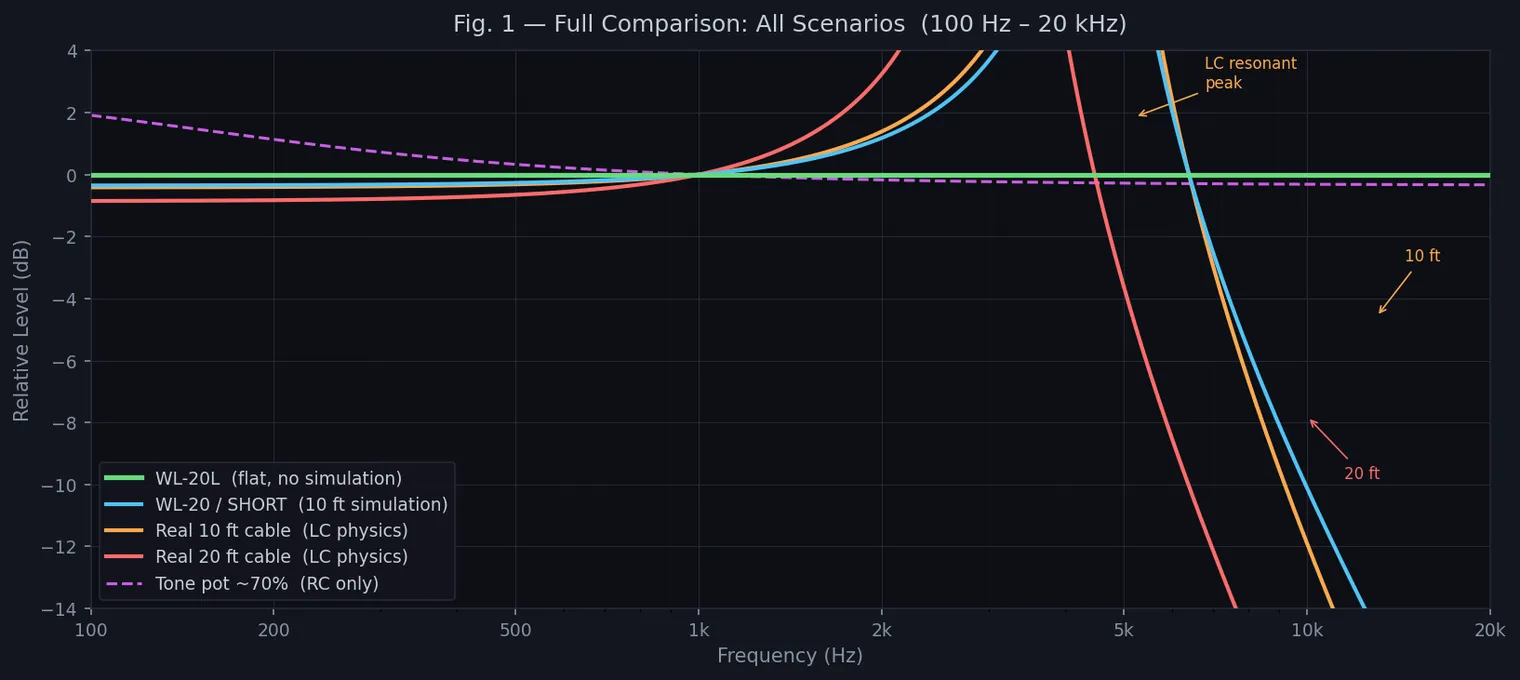
A passive guitar pickup is an inductor - a coil of wire wound around magnetic poles. A PAF-style humbucker like the Seymour Duncan SH-1 has an inductance of approximately 4 henries. When you connect that pickup to a cable with 300 pF of capacitance, you have created an LC resonant circuit: an inductor (L) and a capacitor (C) in combination. LC resonant circuits are the same principle behind AM radio tuning - the resonant frequency is the frequency at which the circuit stores and releases energy most efficiently. For a typical passive pickup and a 10-foot cable, that resonant frequency falls somewhere between 3 kHz and 7 kHz, depending on pickup inductance and cable capacitance.
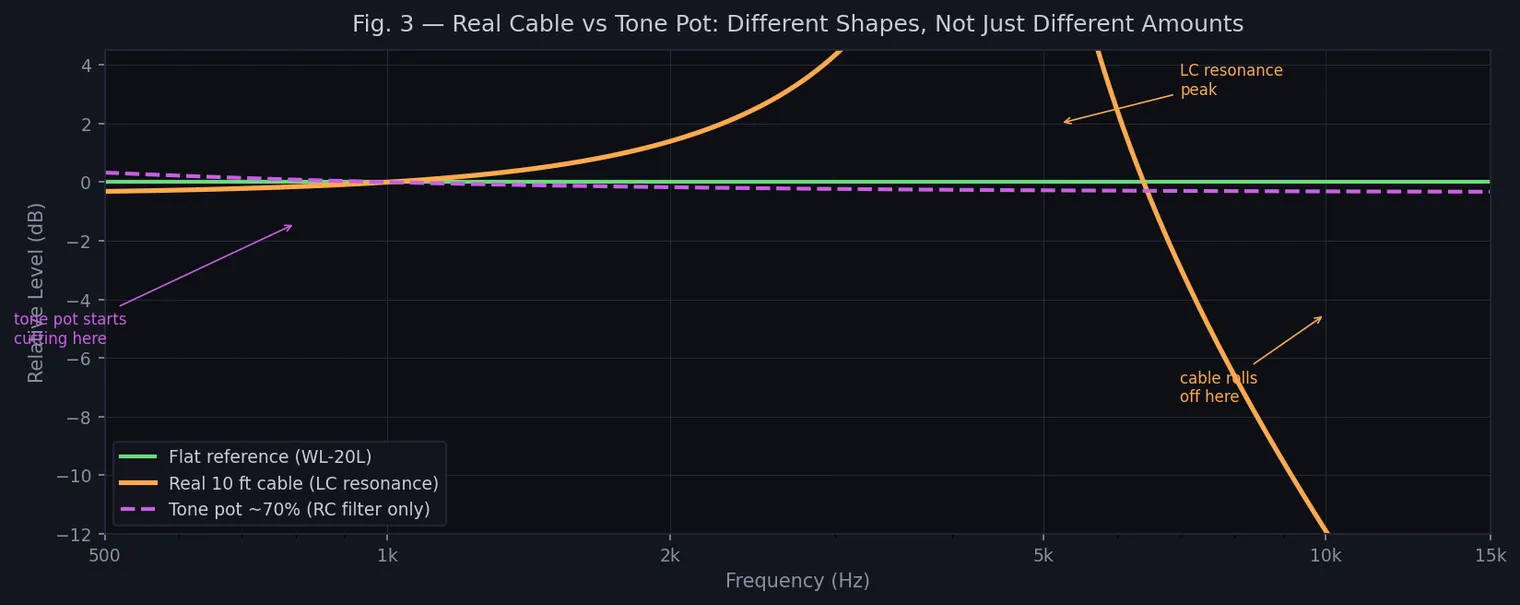
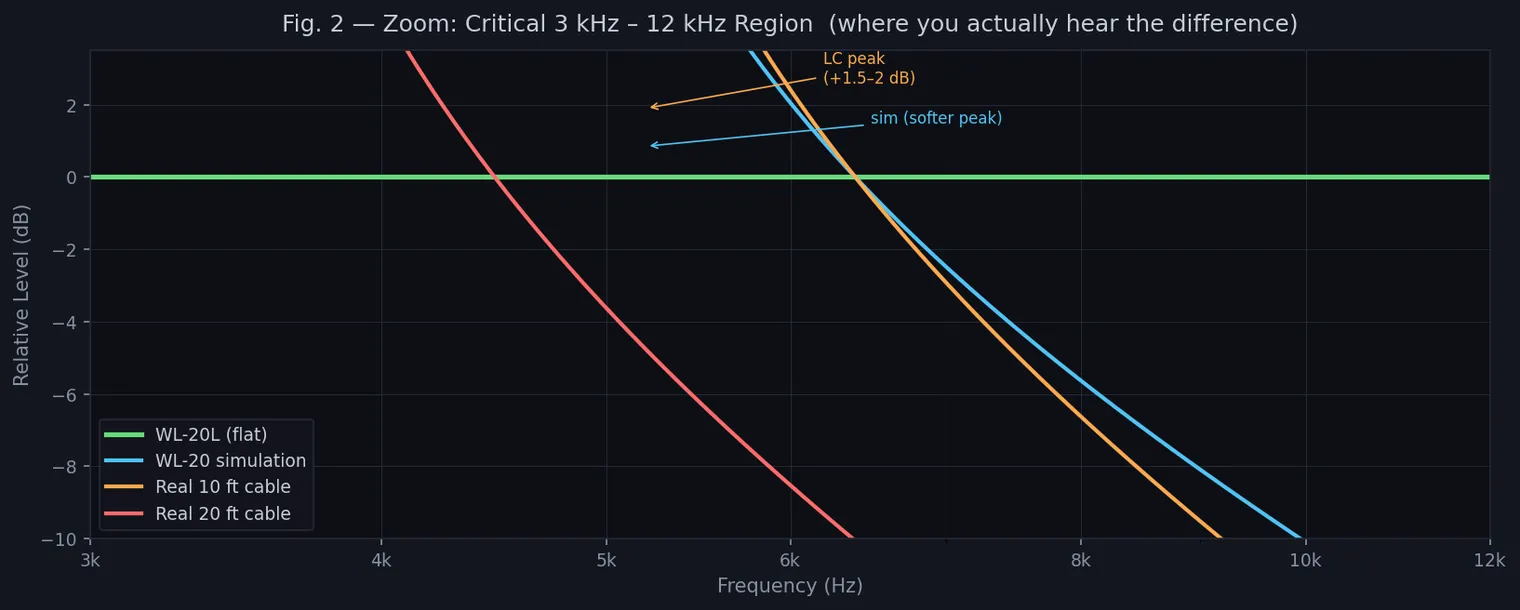
What this resonance produces in the frequency response is not a simple rolloff. It creates a small peak - typically +1 to +3 dB - in the presence frequencies just before the rolloff begins. This peak is the "bloom" or "sweetness" that players describe when they talk about why passive pickups through a cable sound alive. It is a genuine resonance, not an equaliser setting, not a perception - it is a measurable bump in the frequency response that sits precisely in the range where human speech sits, where the ear is most sensitive, where the guitar's voice carries clarity and character. Then, above the resonant frequency, the signal rolls off. Longer cable means lower resonant frequency, which is why a 20-foot cable sounds warmer and a 3-foot cable sounds slightly brighter.
Why the Tone Pot Is a Different Beast
The common wisdom is: if you go wireless and lose the cable's darkness, just roll back the tone pot a little. This is wrong, and the reason why is visible in the frequency response. A guitar's tone control is an RC filter: a resistor (the pot) and a capacitor to ground. It produces a high-frequency rolloff - but a rolloff with a completely different shape from the cable's LC resonance. The tone pot has no resonant peak. It attenuates from the midrange upward with a broad, gradual slope that begins well below the cable's rolloff frequency. Both make the sound "darker," but they are different shapes of darkness. The cable's result preserves the midrange body - the fundamentals and lower harmonics that give a pickup its warmth and presence - before the rolloff takes the top end. The tone pot cuts through the midrange on its way down, thinning the sound as it darkens it. For a SH-1 neck pickup or a Pure Vintage '64 Jazz Bass pickup, this difference is audible and musically significant.
Latency and the Musician's Brain
Going wireless introduces latency: the time between playing a note and hearing it through your monitor or amp. For live instrument monitoring, latency is not a comfort question - it is a perceptual one. The human auditory system, evolved in environments where sound reflections are everywhere, distinguishes between a sound and its echo at approximately 10 milliseconds. Below 10 ms, the delayed signal fuses with the original and is heard as colouration or reverb. Above 10 ms, it is perceived as a separate event - as a delay, a disconnection between finger and ear, the specific unsettledness that makes fast playing feel uncontrollable. The professional standard for wireless musical instrument transmission is under 10 ms total.
Analog RF wireless systems achieve something close to zero latency: the signal travels as a continuous radio wave, and the only delay is the time the wave takes to travel through the air - nanoseconds. The tradeoff is a "compander" circuit (compress-transmit-expand) that can occasionally colour the tone. Digital systems - converting to digital, transmitting, converting back - introduce measurable latency from A/D and D/A conversion plus buffering for error correction. The best digital systems achieve 2–6 ms, well within the imperceptible range. The Boss WL series, at 2.3 ms, is among the best-measured in its class.
The Boss WL-20: Cable Simulation in Silicon
The WL-20 operates on the 2.4 GHz band with proprietary Boss digital encoding, delivering 2.3 ms latency and a flat 20 Hz–20 kHz frequency response. It also includes DSP cable tone simulation - a digital approximation of the LC resonance that a real cable would introduce. Boss describes this as an LPF with a slight mids resonant peak, which is an accurate summary of what the LC resonance actually looks like. The simulation is not identical to the real analog physics - the resonant peak is slightly attenuated, the shape slightly softened - but it follows the same trajectory. For passive pickups, it preserves the character that a flat wireless response would otherwise strip out.
There are two variants that are easy to confuse. The WL-20 includes cable simulation and is correct for passive pickups - the SH-1 '59, the Pure Vintage '64 Jazz Bass pickups, any standard humbucker or single-coil without an active buffer. The WL-20L (the "L" indicating linear or low-impedance) transmits a flat signal with no simulation, designed for active pickups and preamp-equipped acoustic guitars that already have a buffer stage in the circuit. Using the WL-20L with passive pickups raises the noise floor and removes the tonal character the passive pickup depends on. The packaging looks nearly identical. The distinction matters entirely.
The 2.4 GHz Problem in Dense Environments
The 2.4 GHz radio band was originally designated as the ISM band - Industrial, Scientific, Medical - established as unlicensed spectrum primarily for microwave ovens, which operate at 2.45 GHz. The proliferation of Wi-Fi (802.11 b/g/n), Bluetooth, mesh network extenders, smart home systems, wireless mice, wireless microphones, and IoT devices on the same band over the past fifteen years has turned 2.4 GHz into a genuinely hostile environment for any low-power wireless audio system that needs consistent, dropout-free transmission.
Analysis of 82 user reports from a public Boss WL-20 review found that approximately 55% of owners reported negative experiences - and in virtually every case, the cause was RF congestion, not hardware defects. One user's system was rendered unusable by a Wi-Fi router two metres away. Several users lost signal when their smartphone was in the same pocket as the transmitter. A particularly telling case: a smart home heating system eliminated the signal entirely. The Boss WL-20 is an excellent system on paper and in controlled environments. In a dense urban home - Frankfurt, London, any modern city with overlapping mesh networks and dozens of wireless devices per room - its 2.4 GHz architecture carries a real dropout risk.
Users who switched to 5.8 GHz systems reported the dropout problem disappeared almost universally. The 5.8 GHz band is less congested because Wi-Fi on this frequency (802.11 a/n/ac) has shorter range and less penetration through walls, making it less popular for whole-home coverage - which ironically makes it cleaner for wireless audio. The Boss WL-60 is Boss's own 5.8 GHz successor to the WL-20: same 2.3 ms latency, same plug-and-play simplicity, same cable tone simulation, different band. For a passive-pickup guitar in any urban environment, it is the correct choice. Budget alternatives - the Lekato WS50 or Joyo JW-06, both 5.8 GHz - offer dropout immunity at a fraction of the cost, with the caveat of non-replaceable internal batteries that typically last two to three years. The professional choice, if dropouts are simply not acceptable under any circumstances, is the Shure GLXD16+: dual-band 2.4 + 5.8 GHz, automatically selecting the cleanest available channel across both bands simultaneously.
For the headphones: the Beyerdynamic DT 990 Pro stays wired. No wireless headphone available today matches the open-back soundstage, midrange transparency, and tonal detail of a good wired open-back - particularly for jazz, where instrument placement in the stereo field and the natural decay of acoustic instruments are what you are listening for. The guitar cable is the one that trips you up, tangles around the amp, and limits your movement across a room. The headphone cable is short, light, and only inconvenient when it is not there at all. Prioritise wireless where the cable is most disruptive, and keep the wire where the quality it carries is hardest to replace.