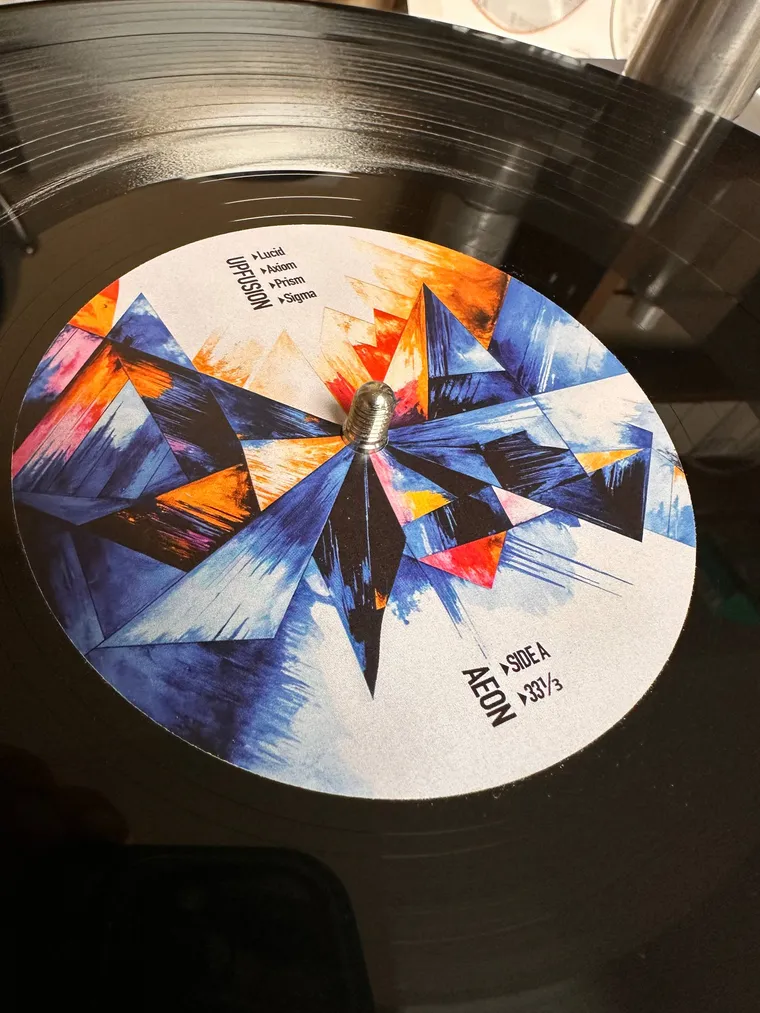
There's a moment when you hold a vinyl record of your own music for the first time, and everything about the journey suddenly feels physical. The weight of it. The grooves catching the light. Your track names printed on a real label. After months of working in Logic Pro, staring at waveforms on a screen, and bouncing files to digital platforms - here it is. Something you can hold, something tangible, something real.
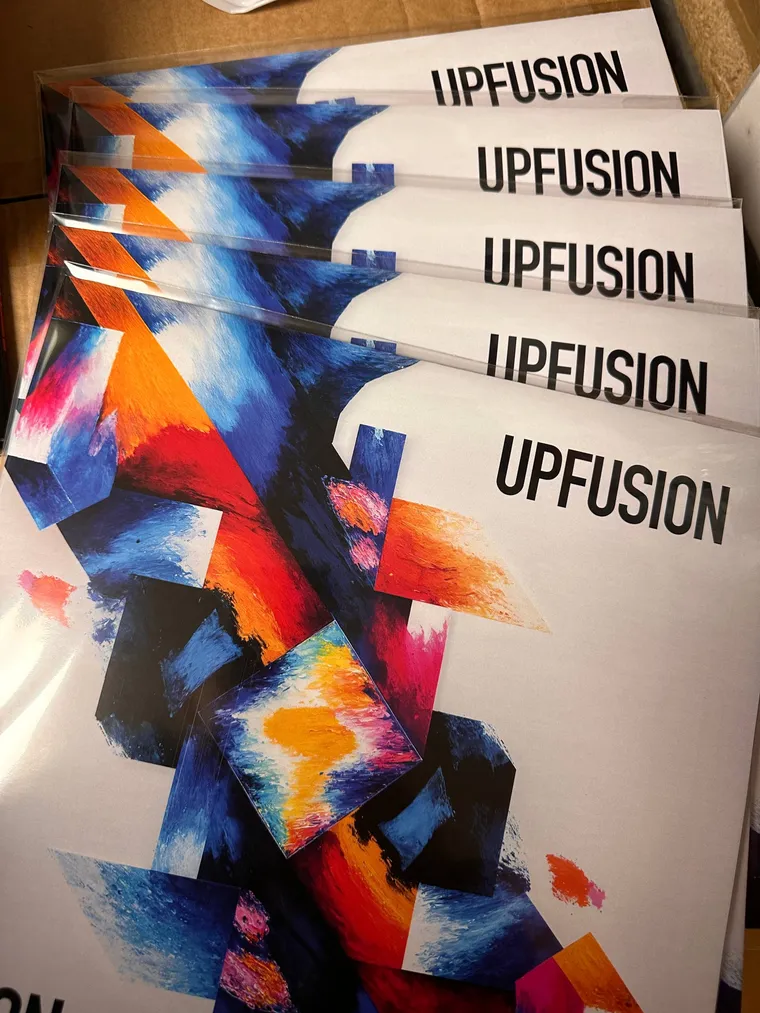
AEON on vinyl. I still can't fully believe it.
The Formats That Shaped Us
Sharing these records with my closest friends brought back a flood of memories. Music has always been inseparable from the format you experience it through, and every era has its own magic.
My first music player was a Panasonic portable cassette player, bought in Germany sometime in the mid-90s. That little device was indestructible - and I mean that literally, because it still works today. There's something about holding a cassette, pressing play, and hearing that warm hiss before the music starts. Tapes taught me patience. You couldn't skip tracks without fast-forwarding through the ones before, so you learned to listen to albums as complete journeys.
Then came CDs, and with them a small revolution. The clarity was startling after years of tape. But the real love affair was with CD-RW - the rewritable disc. The ability to burn your own compilations, to curate and share music on a physical disc you made yourself... that was a superpower in the late '90s and early 2000s. I burned more compilations than I can count.
My first digital player was a tiny device with 512 MB of storage. Half a gigabyte. That was maybe 8-10 albums if you were clever with bitrates. But carrying your music library in your pocket, untethered from discs and tapes - that felt like the future. And then the iPod arrived. The Classic. That thin, elegant design with an 80 GB hard drive. Eighty gigabytes. Your entire music collection, every album, every rare recording, all in your hand. It was extraordinary.
Today my listening setup is different: iMac to audio interface to studio headphones, exclusively in lossless formats. No compression, no compromise. Every detail the way it was intended. But there's a special kind of nostalgia in remembering each of those formats - not because they were technically superior, but because each one shaped how I experienced and fell in love with music.
Why Vinyl?
So why go back to the most analog format of all? Because there's something vinyl does that no digital format can replicate: it makes music a physical experience. The ritual of pulling a record from its sleeve, placing it on the turntable, dropping the needle - it demands your full attention. You don't put on a record as background noise. You listen.
When I decided to release AEON on vinyl, I wanted it to be a gift - something I could share with my closest friends and fellow musicians. Not a mass release, but a small, personal run of records that carry real meaning.
The Craft: Pressing vs. Lathe Cutting
This is where it gets fascinating. There are two fundamentally different methods for producing vinyl records, and they use different technologies, different materials, and serve different purposes.
Traditional vinyl pressing is a factory process. First, a lacquer master disc is cut. From that, a metal stamper (the matrix) is electroformed. This stamper is then used to press records from heated PVC (polyvinyl chloride) pellets - the classic "vinyl" material. Pressing is fast and efficient for large runs: hundreds, thousands, even millions of identical copies from one stamper. But creating that initial stamper is expensive, which makes pressing impractical for small quantities.
Lathe cutting (also known as dubplating) is a completely different approach. Instead of stamping from a mold, a precision cutting stylus engraves the audio directly into a blank disc - one record at a time. No matrix, no stamper, no factory. Just a lathe, a stylus, and the music. This makes it the ideal method for limited editions and small runs.
PVC vs. PET-G: Not All Records Are Created Equal
Here's something that genuinely surprised me: lathe-cut records aren't actually made from vinyl at all. The classic PVC used in pressing is too brittle for direct cutting - a cutting stylus (which costs around 300 euros each) would break within the first 15 seconds of attempting to engrave a PVC disc. PVC is designed for the heat and pressure of stamping, not for the precision of a lathe.
Instead, lathe-cut records are made from PET-G - polyethylene terephthalate glycol-modified. It's a completely different polymer with properties specifically suited to direct engraving. A few years ago, the record-making community recognized PET-G as the superior material for lathe cutting, and it has become the industry standard for this process.
The advantages of PET-G over PVC for lathe-cut records are striking:
- Chlorine-free - PET-G contains no chlorine, unlike PVC
- More flexible - Its greater plasticity makes it ideal for precision cutting
- 8-10x more durable - PVC pressings typically begin showing audible wear around 100 plays, while PET-G lathe cuts can reach 800-900 plays before degradation
- Shatter-resistant - PET-G bends rather than cracking, unlike brittle PVC
- Special lamination layer - PET-G blanks include a dedicated coating optimized for the cutting process
- Superior sound quality - All sonic parameters match or exceed traditional pressings
So the next time someone says "vinyl record," remember: if it was lathe-cut, it's technically not vinyl at all. It's PET-G. And frankly, it's better for it.
The Craftspeople Behind the Records
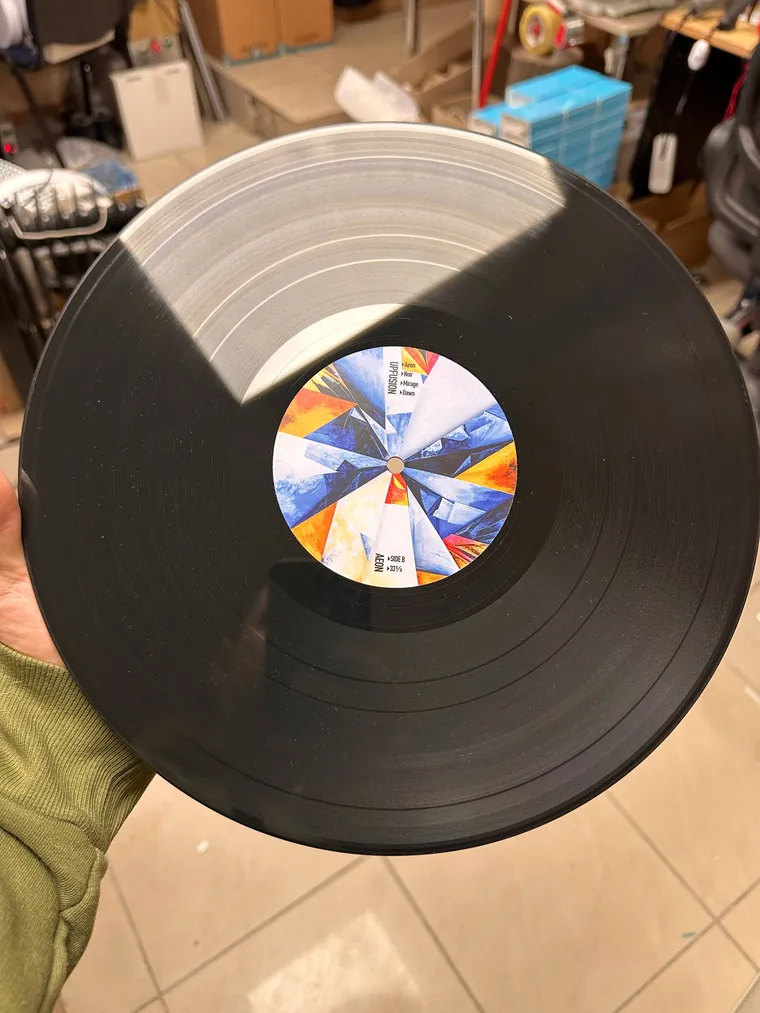
I found an incredible team of specialists who operate their own lathe-cutting studio with professional-grade equipment and deep expertise in the craft. These are people who genuinely care about every groove they engrave. The quality they produce exceeded every expectation - these aren't mass-produced factory goods, each record is individually crafted with meticulous attention to detail. From the precision of the cut to the final quality check, you can feel the dedication in every disc.
Hearing AEON play from a record they cut, with that warm analog character layered over my digital production... it was a genuinely moving experience. The low-end warmth, the subtle crackle of a needle tracing the groove, the way the stereo field opens up differently from a physical medium - it added a dimension to these tracks that I hadn't heard before, even after hundreds of listens in the studio.
Designing the Artwork
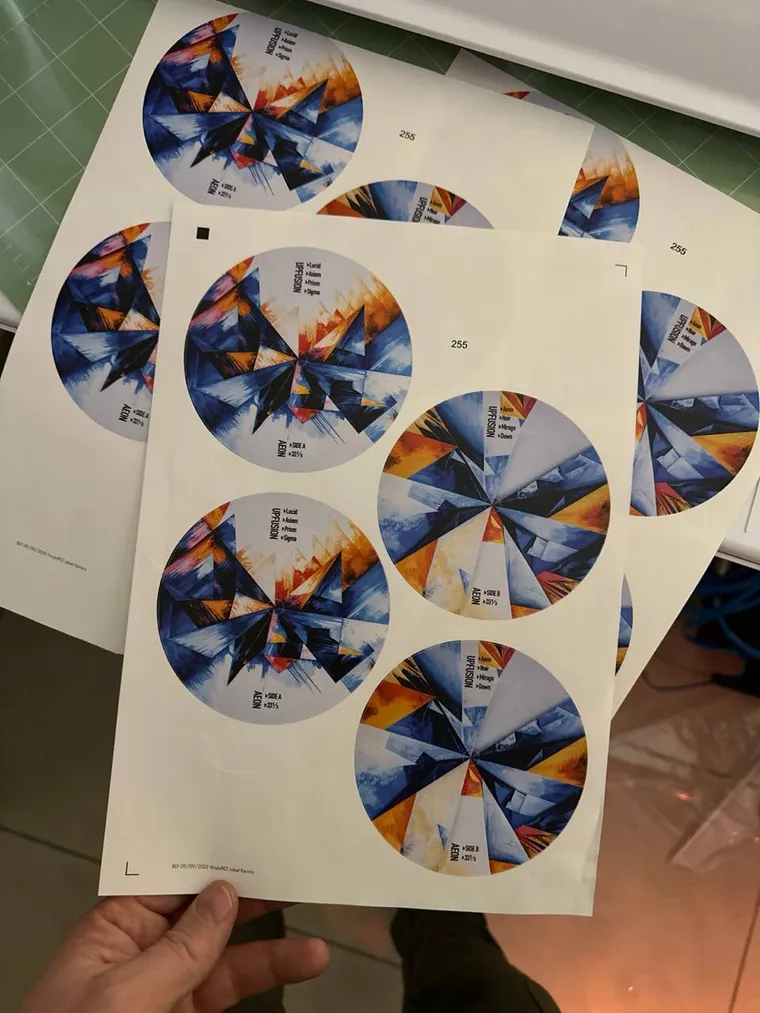
Before the records could be cut, they needed artwork - and I decided to do it myself. I started with zero knowledge of print design, so I called a good friend who works as a professional designer. That conversation was eye-opening. The first thing I learned was the fundamental difference between vector and raster graphics.
Raster images (PNG, JPEG) are composed of a fixed grid of pixels - tiny colored dots. They look great at their native resolution, but scale them up and you get blurring and pixelation. Vector graphics (SVG, AI, EPS) are mathematically defined paths, curves, and shapes. They can scale infinitely - from a record label to a billboard - without losing a single detail. For print work, especially on a small, precise surface like a vinyl label, vector is essential. Every line stays razor-sharp regardless of size.
Armed with that knowledge, I decided to surprise my friend and do everything from scratch. I used a combination of AI-generated concepts for the initial visual direction and Adobe Photoshop for the final composition, carefully ensuring the output met print-ready specifications: proper resolution (300 DPI minimum), CMYK color space considerations, and correct bleed margins for the circular label format. The whole process was a creative adventure in itself - a musician learning the language of visual design.
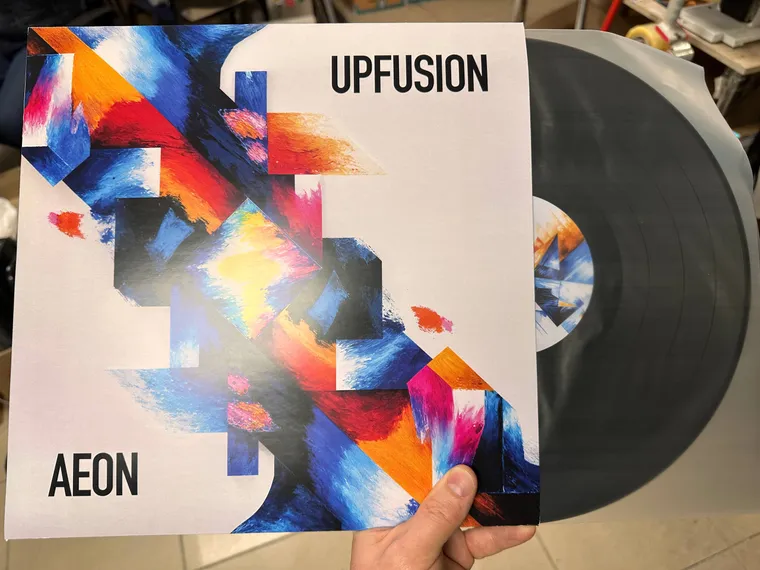
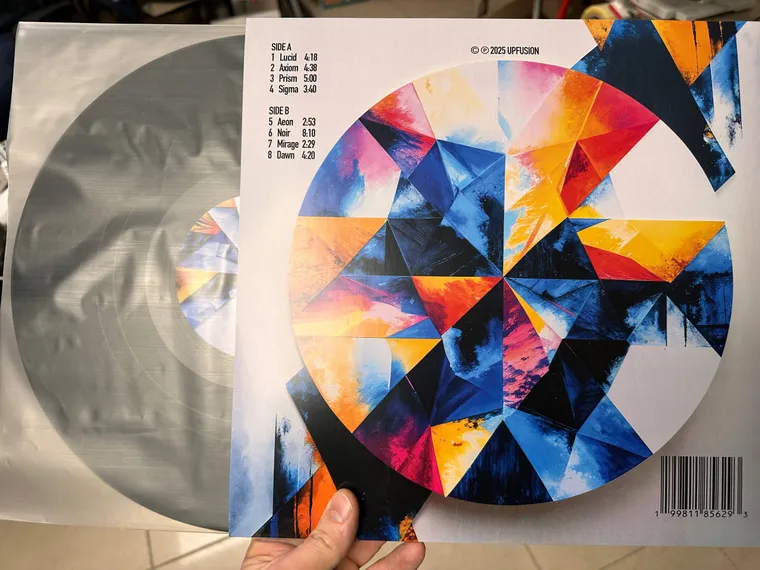
An additional challenge was designing the sleeve - the envelope that holds the disc. Unlike a flat rectangular print, a record sleeve requires a custom die-cut template: panels that fold precisely around the disc with proper flaps, a thumb cutout for easy removal, and exact tolerances so the record sits snugly without slipping. Setting up that template in Photoshop felt daunting at first, but once I understood the geometry - mapping the flat layout to the folded result - it came together more naturally than I expected. One of those things that looks impossible until you start.
When my designer friend finally received his copy of AEON in the mail, the artwork was a complete surprise - he had no idea I'd done it all myself. Seeing his genuine reaction when he pulled the record from the sleeve and recognized the level of work that went into the design was incredibly rewarding. Validation from someone who lives and breathes visual craft every day.
My other close friend lives on a different continent entirely, so handing him a record in person wasn't an option. That's where Elastic Stage came in - their made-to-order service meant I could have a lathe-cut copy of AEON crafted and shipped directly to him, anywhere in the world. The perfect way to bridge the distance with something physical and personal.
Listen to AEON
Before you hold it in your hands, hear it for yourself. Here's the full AEON album - ten compositions on presence, clarity, and the spaces in between.
AEON - Full Album
Own a Piece of This Journey
If you'd like a physical record of AEON or my previous album FATES, you can order your own lathe-cut PET-G copy through Elastic Stage. Each one is made to order, cut individually by the craftspeople, and ships directly to you.
From cassette tapes back in 90s to my own vinyl records in 2026 - what a journey. Music always finds ways to be real.